
Transpower’s Warning Proves NZ Cannot Power Data Centres — Not Even One

Transpower’s Warning Proves NZ Cannot Power Data Centres — Not Even One
By Nigel Gray 5 August 2026
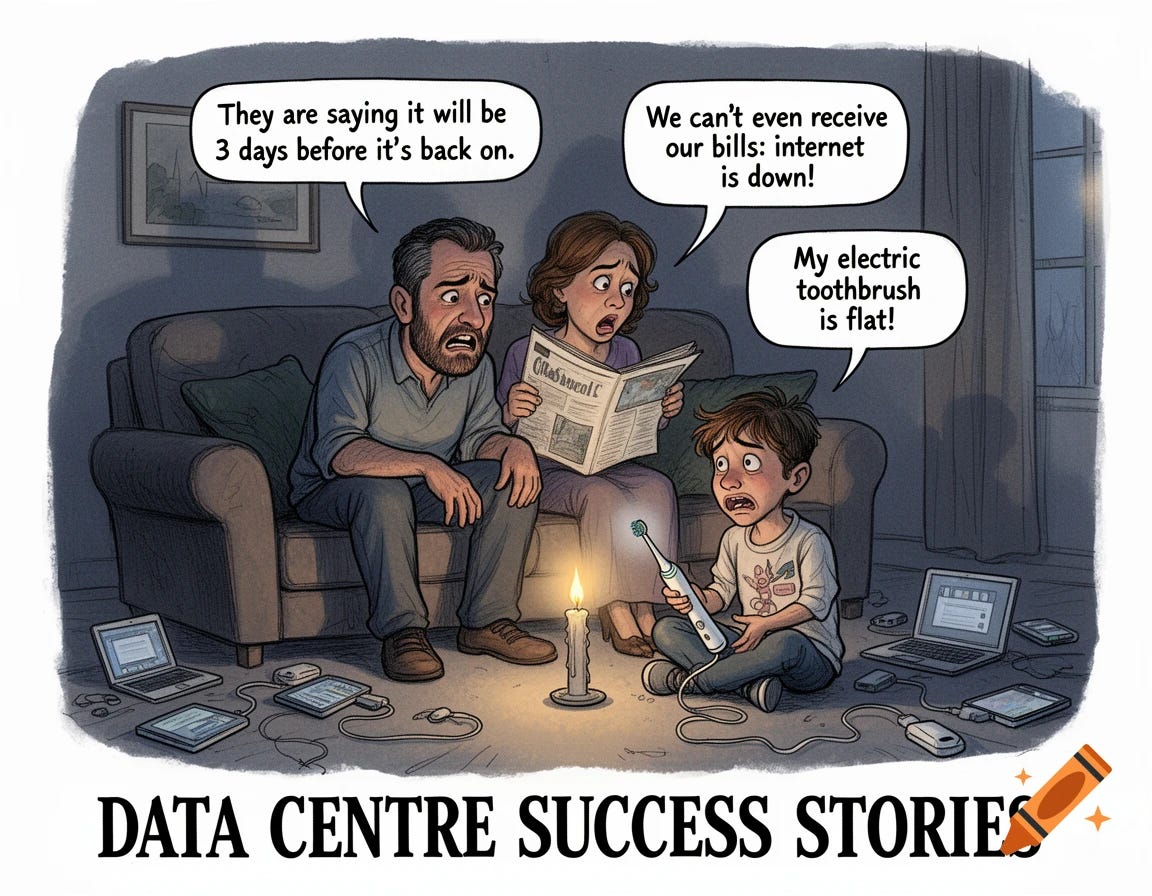
Introduction: The Warning That Should Have Stopped Everything
On 5 August 2026, Transpower issued a nationwide power warning.
Not because of a natural disaster.
Not because of a major outage.
Not because of sabotage.
But because New Zealanders turned on their heaters.
That’s all it took.
A cold snap — snow to sea level in Wellington — pushed the national grid to 7.1 GW, the highest peak demand ever recorded. Wind collapsed. Hydro strained. Gas faltered. The grid was one event away from load shedding.
This is the grid before the data‑centre wave hits.
This is the grid without the 200 MW → 1000 MW → 6000 MW baseload demand already queued in Transpower’s inbox.
And this is the warning that proves, beyond argument, that New Zealand cannot power even one hyperscale data centre under current conditions.
1. What Transpower Actually Said — And Why It Matters
Transpower’s warning was simple:
“Electricity supply is tight. Please reduce usage.”
This is not normal.
This is not stable.
This is not a grid with spare capacity.
This is a grid at its limit.
Here’s the visual reality:
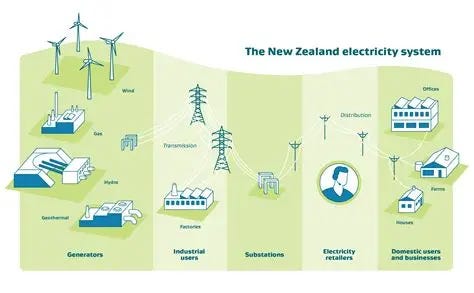
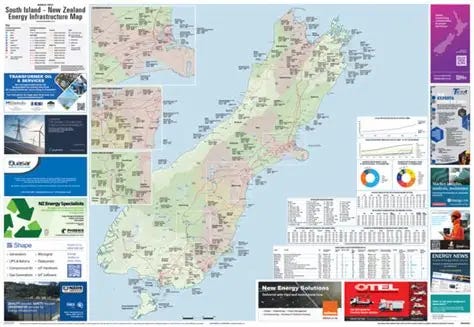
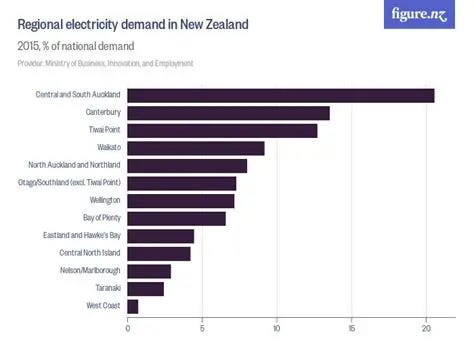
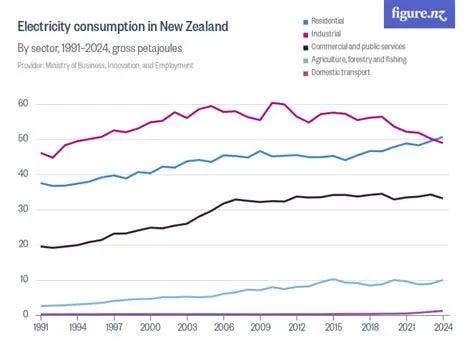
During the cold snap:
Demand hit 7.1 GW
Wind dropped to near zero
Hydro maxed out
Gas was constrained
Reserve margins fell below safe thresholds
This is the grid without data centres.
Add even one hyperscale DC (200 MW) and you push the grid into emergency territory.
Add Datagrid (1 GW) and you push the grid into system collapse during cold snaps.
Add 30 data centres (6 GW) and you exceed the entire national grid.
2. Why Wind Cannot Save NZ
Wind collapses exactly when demand spikes:
Cold snaps
Frost events
Snowfall
High‑pressure systems
Winter nights
Here’s what NZ wind output looks like during winter calm:
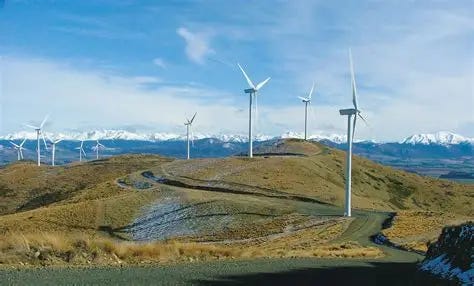


Wind is not baseload.
Wind is not reliable.
Wind cannot power data centres.
3. Why Hydro Cannot Scale Further
Hydro is already:
Fully allocated
Treaty‑bound
Environmentally constrained
Seasonally variable
Hydro cannot support:
1 GW
2 GW
6 GW
of new baseload demand.
Hydro is the backbone of NZ’s grid — and it is already carrying more than it should.
4. Why Solar Cannot Cover Winter Peak Demand
Solar output during winter:
Peaks at midday
Collapses at 4pm
Is near zero during cold snaps
Requires massive storage
Here’s the visual reality:




Solar cannot support data‑centre baseload without gigantic battery farms.
5. Why Gas Is Politically and Physically Limited
NZ’s gas supply is:
Declining
Unreliable
Politically constrained
Environmentally controversial
Gas peakers can supply 1–6 GW, but at the cost of:
Massive emissions
Policy reversal
Public backlash
International credibility loss
Gas is the only technology that can physically supply the load — and the one NZ is least willing to expand.
6. The Hard Math: NZ Cannot Power Even One Hyperscale DC
Let’s put the numbers side‑by‑side.
One hyperscale data centre
200 MW
Equivalent to adding another Wellington to the grid.
One mega data centre (Datagrid full build)
1000 MW (1 GW)
Equivalent to adding Christchurch + Dunedin + Hamilton combined.
Thirty data centres (current grid‑connection enquiries)
6000 MW (6 GW)
Equivalent to 84% of NZ’s entire peak load.
Now compare that to the RNZ warning:
NZ nearly failed at 7.1 GW
With no data‑centre load
With no additional baseload
With no new generation
With no transmission upgrades
The conclusion is unavoidable:
New Zealand cannot power even one hyperscale data centre under current grid conditions.
Not 30.
Not 10.
Not 5.
Not 1.
7. The Land‑Use Reality Behind the Fantasy
If NZ tried to meet data‑centre demand with wind, it would require:
1500 turbines
Spread across 3000 km²
With hundreds of kilometres of new transmission lines
And thousands of kilometres of access roads
Here’s the visual scale:
3000 km² is:
10 Wellington Cities
4 Kapiti Coasts
4 Tongariro National Parks
61% of Auckland
A square 55 km × 55 km
A quarter of Fiordland
19% of the Canterbury Plains
This is not “a few wind farms.”
This is a national‑scale industrialisation of rural New Zealand.
8. The Sovereignty Problem No One Wants to Discuss
New Zealand gives data‑centre operators:
Land
Water
Energy
Grid capacity
Environmental tolerance
Regulatory stability
In exchange for:
Minimal tax
Minimal fees
No sovereign return
No public compensation
No resource‑use payments
No national benefit mechanism
This is the definition of a digital resource colony.
9. The Policy Vacuum Is the Real Crisis
There is:
No national energy plan
No national data‑centre strategy
No generation roadmap
No transmission plan
No ecological modelling
No compensation framework
No security‑of‑supply modelling
No legislation requiring data centres to build their own generation
No legislation requiring cost responsibility
No legislation requiring public benefit
New Zealand is approving data centres without any plan for how to power them, pay for them, or protect the public.
Conclusion: The Warning Has Been Issued — Now NZ Must Listen
Transpower’s warning is not a footnote.
It is not a minor event.
It is not a blip.
It is a national‑scale alarm bell.
It proves, with real‑world data, that:
NZ cannot meet current demand reliably
NZ has no spare baseload capacity
NZ cannot absorb 200 MW
NZ cannot absorb 1000 MW
NZ cannot absorb 6000 MW
NZ cannot power even one hyperscale data centre
The grid is already at its limit.
The land footprint is already impossible.
The ecological cost is already unacceptable.
The policy vacuum is already dangerous.
New Zealand must confront this now — or the consequences will be irreversible.
A nice article, thank you. This discussion could well go a lot further than datacentres as more of the nation's baseload energy requirements are also getting moved onto the electricity grid (which itself currently only delivers one quarter of our TOTAL energy requirements). There is the inevitable move of a lot of direct heating (industrial process/space heating/water heating/cooking) from natural gas onto the electricity grid (with huge capital investment too BTW), and 'progressively' moving light transport energy load (EV & PHEV electric cars), also highly capital intensive. Solar helps, but at the margins only. Essentially the grid stands or falls on the last kW of supply, and with the clock ticking, coal (like any serious country uses) is indeed the only solution. NZ-Inc 'science' should perhaps have been directed at geothermal technology instead of playing whale songs to kauri trees.
One word. Coal.